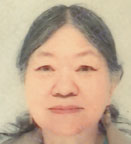
An-li Chang Williams Interview
by Brad Evans
|
The Poetry Kit |
An-li Chang Williams Interview
by Brad Evans
- An-li Chang Williams
- "From graphic designers to writers, from painters to filmmakers, the ancient T'ang poet, Li Bo, continues to make his presence felt within western culture. An-li Chang Williams, author of the biography Li Bo: Poet Immortal (Serendipity, 2003) and the supplement More Li Bo Poems (Trafford, 2004), discusses T'ang poetry and Li Bo's life and influence on the West with Brad Evans.
- T’ang in general:
- An-li, before we discuss Li Bo I’d like to begin this interview talking about the T’ang poets in general. T’ang poets like Li Shang-Yin, Tu Fu, Li Ho, Po Chü-I, Wang Wei, as well as many others, because these poets have inspired so many people from around the world. How did you first come into contact with the work of the T’ang poets? Was it through coursework? A poet friend?
- There is a popular anthology of T’ang poetry called 300 Poems From The T’ang, which we had at home in Singapore, where I grew up. In the course of my haphazard and informal Chinese studies ‘at the kitchen sink’ (as I say in my dedication), my mother would make me hold the book up to her shortsighted eyes. She rifled through the pages for a short poem that contained not too many difficult words for me then, and read it with me once or twice. Then I’d be told to go away and read it over and over again until I could say it by heart.
- What was it about their writing that you found of interest?
- T’ang poetry is immediately different from prose – the way every word has to do full duty – and then the rhymes, the juxtapositions and subject matter. One of my earliest encounters was, I think, by Wang Wei:
- (Ground) orchid leaves are abundant in spring.
- In autumn cassia flowers are elegant.
- Thus Nature’s manifestations –
- Not to invite picking by some beauty.
- Not much rhyme in the translation, but while the orchid (not the cultivated tropical kind) and the cassia were commonplace in Chinese poetry, they were considered exotica in Singapore.
- Do the T’ang poets inspire you today?
- The T’ang poets continually inspire me today, as I compile a comprehensive work on over two thousand of them, with some 25,000 poems. The multiplicity of voices is one factor, the extensive geography is another.
- Are the T’ang poets held in high esteem in China today?
- I am not up-to-date on Chinese cultural thought today. Since the treaties with western powers in the early 20th Century opened ports to foreign trade, the advent of colloquial Chinese encouraged international cultural exchange. This has made considerable difference on cultural thought in China. I don’t even know whether, in spoken Cantonese, they still refer to the Chinese as ‘Tong yan’ (T’ang persons).
- Who were the originators / founders of T’ang poetry?
- T’ang poets frequently harked back to a time of poetic excellence – particularly as exemplified in the aristocratic Xie clan of the 4th Century. The trend then was for ivory tower type ‘Art for art’s sake’ constructs. Poems written ‘according to rule’ persisted, and were highly regarded, but needed time and patience to accomplish. Humming poetry is often mentioned as a leisure pursuit. Poets immediately hummed poems when sent to them by close friends.
- Was poetry writing/reciting a middle class preoccupation, or was it practised by all classes?
- The writing class tends to be an educated one. Nobility did not preclude this, and poems by emperors and the Imperial family are extant.
- What kind of class and ethnic backgrounds did T’ang poets have?
- Li Bo, for a start, was not born in China. A footnote (page 105) in my book describes his conjectured origins.
- Do T’ang poets have a style of writing that is distinctly T’ang or do they have their own individual styles?
- Yes, poets did have individual styles.
- Is it just that period of time which classifies them as T’ang?
- The period of time was 300 years under a single dynasty.
- On Li Bo:
- Why did you decide to write a biography and translate some poetry of Li Bo?
- Why not another fine poet, like Tu Fu?
- Li Bo was considered a more ‘accessible’ poet by the educated generation who taught me. Du Fu (Tu Fu) – the superior craftsman – already had a complete biographer – William Hung of Harvard in 1952.
- In some poetry anthologies, Li Bo appears as ‘Li Po’, in others he is called ‘Rihaku’.
- Can you explain the variations of his name?
- ‘Po’ is the Wade transcript of ‘Bo’, the form of romanization used by the early sinologists like Giles, and followed in this by Arthur Waley. For international purposes, ‘Pin-yin’ became the standard form in 1947. Rihaku is the Japanese version of ‘Li Po’.
- In your biography, ‘Li Bo: Poet Immortal’, you indicated that China, at the time, was far from having a standardised, national language. What was Chinese society like in those times before a nationalised language? What kind of a cultural environment did it foster to give rise to T’ang poetry in particular?
- Confucius exempted the ‘farming’ class from literacy (which was, however, open to all who sought it). Many T’ang poems do complain of ‘vulgar’ local dialect. There are no complaints about ‘fisher songs’, despite them being simplistic. In my work in progress, I have gone briefly into the binding nature of a common written (Classical) culture, and the usefulness of communicating in a few lines of verse - requirements like ‘Please ask So-and-So to send me his herbal prescription for my condition’. On a personal note, I well remember how my father and a close friend in Singapore would get down to brush-pen and paper at every visit, since neither spoke the other’s dialect. They would then chant, appreciatively, each other’s poems in their own dialects.
- Li Bo doesn’t appear to have humble beginnings like with other T’ang poets, such as Li Ho. Would you like to comment on his family’s economic background?
- Very little is known about Li Bo’s family or upbringing. In my Notes [1]I quote scholars who have gone into the business of his lineage. After his father returned to China, and settled in a border prefecture of Si-chuan, he took advantage of his right to land and became a gentleman farmer. Bo, meanwhile, devoted himself to his studies – so successfully that a Prime Minister on his way to retirement was shown his poems, which received high recommendation.
- With this in mind, how was he able to make connections with people who would assist with his career as a poet in later life?
- His poems and his ambitions for preferment commended him to all he addressed himself to. Jobs were not always forthcoming, but his fame spread.
- Did all T’ang poets receive patronage in some way or another from wealthy noblemen?
- What obligations were expected of T’ang poets when they were granted financial support by their patrons? You note that his only official appointment was during the rule of Emperor Xuan-zung (713-756) when he was made a member of the Han-lin (Forest of Pens) Academy.
- Patronage was important – the first patron usually being the chief examiner at the Metropolitan exams. Li Bo bypassed that, and was recommended directly to the Emperor by a poet Meng Hao-ran, whom Bo had met on his travels. Usually a free and honoured house guest, his aptitude for verse stood him in good stead – as they did at Court, where he improvised to order for the Emperor’s musicians.
- How did he survive during the times when he wasn’t employed? What options did Li Bo and T’ang poets in general have if they didn’t have financial support from nobles?
- Once or twice, mention is made of his calligraphing a temple inscription for payment, otherwise hospitality was easy and many poets did, in fact, have official postings. Complaint of inadequate financial renumeration was frequent, however.
- You do mention in your biography that on occasion he sometimes sang his songs for soldiers in military barracks. What did the military think of poetry?
- Many posted military commanders expressed themselves ably in verse. One notable commander was Cen Can, a contemporary at court with Li Bo.
- Like Wang Wei, Li Bo appeared to be a poet who constantly had itchy feet. In your biography, you state that he travelled extensively throughout China ‘…from the borders of Si-chuan in the west to Yang-zhou (modern Shanghai) on the east coast’.
- Travelling was necessary to get to one’s post. Not everyone could be given a job in the Capital city, Chang-an. Li Bo, I guessed, was given a large imbursement by his father-in-law once his young wife was pregnant, to go and see the world and meet people if he was to get on. In fact he squandered large sums on his lifestyle as a ‘knight errant’, rescuing his noble acquaintances from debt or other trouble.
- You mentioned in your book a Chinese custom that is unusual in the West, where men will sometimes court their future wives while being absent for years and not see them in this time. Li Bo appeared to do this before and after he is married. Not only with one wife, but successive ones as well. Can you explain the reasons for this custom, where a couple are meant to be in love with one another, and yet are infrequently together?
- It is not exclusively a Chinese custom – the man (particularly one in government) went wherever his posting took him and the woman took care of the household (particularly if there is much land and small children to bring up). A man posted far from home is entitled to take a secondary wife for the purposes of the distant establishment. ‘Love’ and ‘in love’ are concepts that are realized differently from one culture to another.
- There’s another custom I’d like to discuss and that is how poets regarded their peers during this time. There was a poem, ‘For Tu Fu’, allegedly written by Li Bo and addressed to Tu Fu which some scholars have claimed to be too insulting to have been written by Li Bo. On the contrary, David Young, another translator of T’ang poetry, said in his book ‘Five T’ang Poets’ [2] that this perspective is ‘laboring under a misplaced notion of decorum.’ Would you like to comment on this? Could T’ang poets write about one another in this way without being considered offensive?
- The poem ‘To Du Fu’ is, I think, subtitled ‘a tease’. Li Bo was a great teaser and had no compunction about giving offence. His fellow Sichuanese, of modern times, made the famous remark about cats – ‘who cared if they were black or white, as long as they caught mice?’
- Taoism is a religion that I’m not too familiar with and in the preface to your supplement ‘More Li Bo Poems’, you indicate that Li Bo was a ‘confirmed Taoist’.
- The favoured religion in T’ang times was Buddhism. The Scriptures arrived from India, having been laboriously sent for, and the translation of the Diamond Sutra gave rise to the invention of woodcut printing. Empress Wu was a devout Buddhist, and built innumerable temples in her favourite city of Lo-yang. Taoism was based on the Tao-de-jing and the sayings of one Lao-zi (the Old One). ‘Tao’ means ‘The Way’. In practice Taoism is non-ceremonial, with the emphasis on purity resulting in Taoist nunneries being wonderful places to stay, sit in quiet and well-tended landscape. Li Bo, staying with Yuan Dan-qiou, met and wrote of Taoist women. The popular offshoots of Taoism are alchemy and physical extra-control (levitation, for instance). Taoism was non-binding. When Emperor Xuan-zung desired the already married Guei-fei for himself, he first made her a Taoist nun.
- Oeuvre:
- Li Bo appears to have been a prolific poet. You mentioned his patron, Li Yang-bin, posthumously published 30 rolls of Li Bo’s work under the title Grass Hut anthology.
- The Grass Hut edition of Li Yang-bin survived into the following dynasty (the Sung), when it became incorporated with poems previously left with another patron, Wei Wan, to form the first Sung Edition of the Collected Poems of Li Bo. Subsequent editions have been reprinted to our own day.
- In your bibliography, you list a Li Bo Harvard Concordance.
- The Li Bo Concordance was a University of Kyoto compilation listing 1,000 poems of Li Bo and ascribing dates to them. Some of the dating is circumstantial. I have had to rearrange whole batches of dates, according to my own reading of the Life, based on clues from the poems themselves.
- I can sense strong connections with human existence and the wildlife that surrounds it in T’ang poetry and Li Bo is no exception. From what I have read, he appears heavily influenced by the seasons and writes quite vividly about the botany of various locations, the weather, loneliness, his oft-distant relationships, as well as his love of wine. Why are these subjects so predominant in T’ang poetry? Why are landscapes, the weather, and even the constellations continuously mentioned?
- The seasons figure conspicuously in T’ang poetry. Poet-officials who travelled to their postings, and were dependent on the state of the tides, etc. could not but take account of the weather. Loneliness might be a poetic ‘pose’, just as love is in 16th Century English verse. There is the universal dichotomy between ‘town’ (dust) and country (nature, often wild – and Taoism abets this), and a nostalgic harking back to the uncomplicated life of one’s student days, the cult of the ‘noble’ peasant and of legendary paragons. Du Fu’s ‘connections with human existence’ as you put it – were very real. He travelled from post to post with his large and increasing family in a state of impoverishment, the children ragged and starving. Landscapes are continuously mentioned because one always rode through them on horseback, or when boating from one point to another, and to moor for the night by banks known or unknown, in a reed or other form of shelter.
- You mention in your biography that there are strict formal structures in T’ang poetry, what are some of these?
- The ancient Book Of Songs recommended for study by Confucius to his disciples, and originally thought to have been compiled by him, did not follow any metric rules but are full of metric felicity. Part one is entitled ‘Guo feng’ (‘airs of the State’). The State features in the subject matter – the intrepid habits of well-thought-of Princes of the Golden Age (founding of the Zhou during the –9th Century on) who rose at dawn for the concern of the ‘people’, etc.
- I can see in your supplement that you have translated some of Li Bo’s ancient airs, you classify these as a free form practised by Li Bo. Would you like to comment about this style of writing, particularly in view of the highly structured poems that we can see in the other work of Li Bo? What was the purpose of the ancient air? Were they for singing?
- When Li Bo called some of his poems ‘gu feng’ (‘ancient airs’) he may have been harking back in the best erudite tradition to these – with their freedom from metric and other constraints like ‘parallelism’ – constructing a second 7-syllable line so that it forms an inversion of the first. And the less obvious the better.
- For example:
- A reply to Li Zhan – Wei Ying-wu
- Last year, among the flowers, I met, then parted from you.
- This day, flowers in bloom – another year has gone…..
- I can see, from my copy of the Qian-jia shi (Poems of a Thousand Masters), that somebody (probably my father) has marked the tones ‘flat’ and ‘oblique’ – not the four tones of spoken Mandarin – the observance of which were also an important requirement.
- Dilemmas in Translation:
- I would like to include here some varied samples of a translated poem by Li Bo, but translated by various people (perhaps one version also by you) and discuss the variations of the translation and why they can be compared. With these samples in mind, I would then like to ask what some of the problems that you see with translating Chinese into English?
- I had already examined some of these in my MA theses, English Translations of Chinese Poetry (London 1951-2). Here is the well known 4-liner by Li Bo, literally word for word:
- Bed fore bright moon light
- Doubt is ground-on frost
- Raise(d) head gaze clear moon
- Dropp(ed) head reminisce home country
- H. A. Giles (Gems of Chinese Literature (Verse), 1898):
- I wake, and moonbeams play around my bed
- Glittering like hoar-frost to my wondering eyes
- Up towards the glorious moon I raise my head,
- Then lay me down, and thoughts of home arise
- W. J. B. Fletcher (Gems of Chinese Verse, 1898):
- Seeing the moonbeams by my couch so bright,
- I thought hoar-frost had fallen in the night.
- On the clear moon I gaze with lifted eyes;
- Then hid them full of home’s sweet memories.
- Florence Ayscough & Amy Lowell (Flower Tablets, 1921):
- In front of my bed the moon is very bright.
- I wonder if that can be frost on the floor?
- I lift my head and look full at the full moon, the dazzling moon.
- I drop my head and think of the moon of old days.
- Shigeyoshi Obata (The Works of Li Po The Chinese Poet, 1922):
- I saw the moonlight before my couch,
- And wondered if it were not frost on the ground.
- I raised my head and looked out on the mountain moon;
- I bowed my head and thought of my far-off home.
- Bynner & Kiang (The Jade Mountain, 1929):
- So bright a gleam at the foot of my bed –
- Could there have been a frost already?
- Lifting myself to look, I found that it was moonlight.
- Sinking back again, I thought suddenly of home.
- Soame Jennyns (Poems From The T’ang, 1940):
- In front of my bed there is bright moonlight.
- I think there must be hoar-frost on the ground.
- I raise my head and gaze at the bright moon.
- Lowering it I think of the old country.
- Wong Man (Poems From The Chinese, 1950):
- On bed bright moon shone
- Thought frost on ground foamed.
- Raised head faced bright moon,
- Lowered head dreamt of home.
- An-li Chang Williams:
- Bright moonlight by my bed:
- First I thought it was ground frost.
- I gaze up at the moon,
- Bow my head, remembering my homeland. [3]
- My prime rule in tranlsation is not to add or subtract anything from the original. By having put down whatever words I can in English while holding the Chinese in my head (or ear), I am able to read the English back and hear something like the Chinese through it. Following this, I leave the piece well alone.
- With longer and more involved poems it is not so simple. I find myself nowadays using every trick under the English grammatical sun to get the meaning construed, and if the result reads like verse not strict and at the present day – it will again have to do. I do not claim to model myself on a highly regarded antecedent like Arthur Waley. William Hung took a humble step back, and admitted to prose translation only.
- Books by An-li Chang Williams:
- An-li Chang Williams biography, Li Bo: Poet Immortal (2003), is available from Serendipity at: Suite 530, 37 Store Street, Bloomsbury, London.
- ISBN: 1843940426
- The supplement to her biography, More Li Bo Poems (2004), is available from Trafford Publishing (UK) Ltd., Enterprise House, Wistaston Road, Crewe, Cheshire, CW2 7RP. ISBN: 1412026768
- Also see - http://www.trafford.com/04-0504
- [1] For the Notes see pp. 99-131, An-li Chang Williams, Li Bo: Poet Immortal, 2003, London: Serendipity.
- [2] David Young, Five T’ang Poets, 1990, Oberlin (Ohio): Oberlin College Press.
- [3] An-li Chang Williams, Li Bo: Poet Immortal, p.11