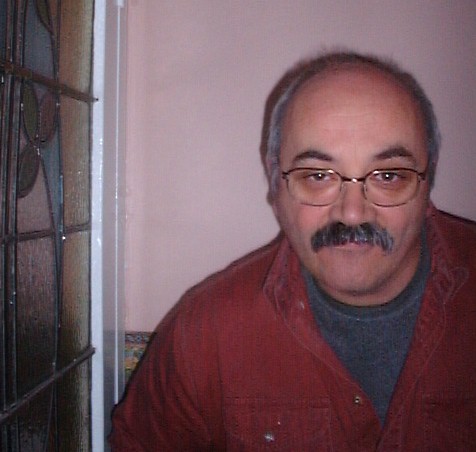
Tell me about your background. Where were you born and brought up?
I was born in Liverpool, and have lived there, or in the area, on and off for most of my life. I am 48, married to Hilary, with six fabulously wonderful children (who do their best to keep me impecunious), two wonderful shoe chewing poodles, a crazy swing-ball playing rabbit and a health-freak hamster.
Do you come from a literary family?
No, but I have always felt impelled to write and drawn to music although there was no active writing or reading going on around me when I was a child. In fact I would say the opposite was probably true. But to add grist to the nature/nurture argument, I was adopted and later found that my birth parents families where highly literate and contained other writers and musicians.
When did you start writing poetry?
For some reason poetry was always something I wanted to do. My first poetry came through the song lyrics I heard on the radio, and I can always remember trying to write songs from a very young age. Mostly it was just intuitive rhyme.
What were the books\events that most influenced your beginning as a writer?
I was only in my early teens when the Cuba crisis, came along. Watching the tension rise and seeing the effects it was having, really made me grow up and accept the world was a different place to what I had believed before. The first poem I wrote which was a stand alone poem without music, was a response to that. The sudden arrival of the Beatles shortly afterwards, and the effect that had on the art community in Liverpool, was enlivening.
What sort of poetry did you begin writing - what were its main themes?
War, more war, doom and gloom, adolescent angst. The first poetry worth the name that I brought out into the light of day, was all angst ridden adolescent tosh. Which I read to groups of angst ridden adolescents at poetry nights in Liverpool in the early 1960's.
and its techniques?
The technique, because I really only knew one, was to play with the sounds of words and create puns and punning word combinations. I was heavily influenced by the Liverpool scene - felt myself to be a part of it - though in retrospect it was a very amorphous thing at best. You must remember that in Liverpool we call ourselves "Liverpudlians". To me that name is a poem, instead of Liverpoolians we turn the pool into a puddle, a metonym that is hard to match, as it says so much about the Liverpool way with words, and the strand of self deprecating, probably Irish influenced humour, which is mixed with a sarcastic hard edge that passes as wit or Liverpool humour. It is a unique place in the way that Glasgow, Dublin and New York are unique. The people who come from those places are touched with a pride in their roots and an attachment to the place that others cannot even begin to understand. Or so we like to think - see that's part of the arrogance that comes with being from a place like that.
To what extent do your 'roots' influence what you are writing now?
Almost totally. I write quite personal pieces about places and people I know, and situations from my own background which I am familiar with. Obviously I am also open, as everyone is, to many other influences, but my poems and stories grow from my background and personal experiences. Perhaps the biggest influence is in terms of the voice I think and write in which is strongly accented with its own cultural rhythms and references.
How did you first go about getting your poems published?
For many years I thought of myself exclusively as a performance poet,
and
was not convinced that my poetry would stand up to reading, because I
thought it depended on my accent and pronunciation. But this perspective
changed after I entered a competition in the late 70's and won a major
prize, I can't remember what that was now but it really gave me a boost at
the time. I
have been a supporter of legitimate competitions ever since and enter quite
a lot of them,
picking up quite a few prizes along the way. It was at that point I started
to think about
the words on the
page having a
life apart from me, and I started to let go of more poems. I was
fortunate
to have an agent due to other, technical writing, which had been
successful for me.
The first chapbooks where published by Gail Keech, through her own
publishing
company, Grove, and several more followed. These where produced to
support
readings and tours and sold quite well.
In 1994 I received a bursary to write a series of poems based on an idea
I had about places and people being a reflection of each other. This
became "Drums at New Brighton" (Starwood Press 1998), which has been successful in
terms of readings and sales.
I have recently moved to another publisher, Wirral Media. This is a small
press which is about to reissue some of my technical titles and is interested in producing
some of my poetry. Though like most people I would like to be published by a
mainstream publisher I tend to be tied up most of the time in contracts with publishers which are usually exclusive. My dream is to be published by Black Sparrow Press or City
Lights, but I have never approached anyone with that in mind so they have not been able to turn
me down yet.
How does the way you make a living influence your poetry?
I earn my living as a writer, lecturer and performer, with a bit of journalism
thrown in, as I have for over twenty years. I have written many technical
books, and some for children. Being a full time writer means that I have
limited
the time I spend doing other things, so I am often sitting looking for
things to write about and exploring things which I turn into
poems.
I plan several tours each year, and a number of single readings, and
this is an impetus to produce new poems. I also get the opportunity to read many other new books and pamphlets which are sent to me for review, and students' work from my university
courses. The fact I am steeped in such wonderful material is a spur to me to keep
writing.
Being self employed also means that I can do pretty much as I
want, so when I can on Wednesday afternoons I go to the Inklings writers group, and
again, it is the right environment for me to produce new material
regularly. I also hold a writers group on Monday afternoons in Liverpool University
which is a spur to production, it also helps keep me in touch with
real people.
I also practice on a number of instruments each day for several hours,
this often brings poetry and music together and the rhythm of music helps me
write more structured poems which turn into songs.
So if the question is about if I write about my work, well I suppose I
do as most of us do, but the biggest influence my work has is in creating the
time and the impetus for me to write. Writing journalism is also a very good
discipline as most of the time you are working to deadlines.
To some the term 'teaching poetry' is a contradiction. I suppose most people can learn to write verse, but how do you get them across the bridge to poetry?
Well to be honest, no one can teach anyone else to do anything. People
have a tremendous capacity to learn and teachers can create the
conditions in
which learning can take place. Ultimately the teacher is a facilitator.
In teaching creative writing and poetry however, as well as being a
facilitator, the teacher is also a midwife.
I think everyone has the capability to write poetry, but before you can
you
need to be able to recognise what poetry is and then feel impelled to
write
it, or perhaps that should be the other way round. It is the case that
stress or strong
emotions create a drive in some people to write poetry. It is almost as
if the brain is
trying to get rid of a build up of static. Putting the pen to paper
(even figuratively at the
keyboard) creates the conditions in which the discharge can take
place. It is in
those moments when the poem springs unbidden and unrehearsed that there
needs to be a lot of tools at the writers call to help them keep control
and get the poem down in a reasonable form. A writer who reads little,
has a limited word hoard or cannot manipulate
sentences or look for alternatives, will end up with something trite or
twee, while a more able writer will use that moment as a force for
creativity to write at least the first draft of a
worthwhile piece.
The function of the lecturer or teacher in this contract between the
words
and the writer is to provide additional tools, and support at a time
when the
student needs it.
Sometimes it is just giving permission for the student to write. So many
people want to
write but are inhibited by things that had been said to them as children, by
parents or
teachers. I help them put that behind them and overcome their fears of
being laughed at
or mocked for making mistakes. The first thing I say to them, as I do to
everyone who is
trying to do anything creatively is that there are no right answers. What
any courses
involving creativity and individual vision teaches is how to avoid the dead
ends or how a
particular technique can help get the result you are after. Creative
writing is not maths or
science where a degree of precision is required. I tell them that few
writers write
anything worthwhile, but many have rewritten pieces which has transformed
those pieces
into something special.
The exercise he or she sets and the materials studied
will help the student learn basic key skills and therefore assist them
in developing as technicians. When I lecture on the skills used in
writing poetry I ease my way in through the imagist window, follow
threads into Beat and on into post modern realism and innovative
poetics. I like to let students see, hear and feel as many examples of
poetry as possible so that
they abandon preconceptions and expectations.
In 1999 I was fortunate to received a bursary which involved me holding
poetry workshops in schools, and youth clubs. The experience was
something
I will always remember, as the appetite the children had for poetry was
astonishing. Once they started writing there was no stopping them. In
one school I had to
take up the papers so that the children would go out for their break.
Once a child's imagination is set free the results can be wonderful. As
I
left each site I kept hoping that one or two or more would carry on
writing
poetry and find it a force in their lives. But I cannot understand what
turns poetry loving
children into adults who do not care for it, unless that is a perverse
effect of their
education.
The web is the great leveller. Everyone's opinion is as important as
everyone else's, it is democratic, and you can be shouted down. This is
its
strength and its greatest weakness. It tends to gravitate towards a
consensus, or give so
many views you need only pick the ones that correspond to your own. It
is also true that you cannot trust information found on the web. You can
never be sure of its source or veracity.
The web has the power to bring poets, writers and artists together in a
way which has never been possible before. Already you can see on-line
discussion lists with contributions from around the world. I hope that the web will
allow new collectives to form which will empower a new approach to writing and a
wider influence for cultural differences.
Although my fear is that with the huge amount of on-line writing taking
place that there will be a dumbing down or a polarisation of style, but
that
is the gloomy view. On the positive side art has often moved forward
when groups have
gravitated to a central idea and redefined their art through the
collective in a supporting
and sometimes competitive way. Good examples are the Beat poets or the
Liverpool Poets.
Can you describe your most effective working method? Do you wait for inspiration, or sit down every day with the intention of writing?
I write something everyday. Though many of the pieces come to nothing.
I
scribble on bits of paper, on a word processor and in note books.
Working
as a professional writer means I sit down everyday with the intention of
writing, sometimes it turns out to be a poem, sometimes a song,
sometimes
something else.
For some children's poetry you are working to produce verse on
particular
topics or themes. To be honest although I put a lot into them, and I am
proud
of them, I think of them as exercises and in some ways artificial. Other
poems come
unbidden and demand to be written.
I like to think that although I write for set times each day, I am also
ready to write at any time when I need to.
How do you decide that a poem is finished?
This is my worst thing. I keep going back to old pieces and thinking of
changes I would like to make. I have now convinced myself to accept the
discipline of not doing that, unless the change is necessary for
grammar.
Other than that, I consider a piece finished when I can read it through
aloud and it sounds right to my ear. I trust my ear more than my eye,
perhaps
because I equate poetry to music and performance. What it looks like
on paper is secondary to what it sounds like.
Of course there are some poems which cannot be tested in this way,
shape poems or other visual styles for example.
If I find I use a contraction when a piece is performed, then I will
want
that contraction to be in the written version. For me the paper version
should
be the performed piece, otherwise I don't think the reader can get the
poets
voice accurately.
How important to you are formal workshops, or getting the opinions of other poets about your work-in-progress?
Workshops are extremely important to me. We are all a little insecure, but when insecurity was given out I was at the front of the queue. I like to get feedback as soon as possible on a poem. Which is why I often introduce new poems at my Monday afternoon university workshops, or at the Inklings group on Wednesday afternoons. I also read at the Dead Good Poets in Liverpool every month to get the feel of new pieces in performance. I do get problems from people who turn up at these readings expecting to hear some familiar pieces, and then hear me trying out new poems which may not quite work, so I throw in the occasional familiar piece.
To what extent if any do you collaborate with other artists?
I don't really collaborate on poetry but that is only because the
opportunity has not arisen. I collaborate on other projects,
anthologies which I have
edited several books I wrote as collaborations, and a new project with
Nick Hancock
which is a lexicon of poetic and literary terms. I have also been
involved in several renga
cycles.
Working with others is something I enjoy and find adds another dimension
to a project. So I am open to offers.
The collaborations which I am most involved with are in performances of
poetry, and music, either my own or other peoples.
Who do you write for? - Do you have a particular audience or person in mind?
I suppose I must, but it is an amorphous idea. I think I try to write the sort of poetry I couldn't find when I was younger, so I suppose I write for the younger version of me.
Does poetry have to be 'simple' to get a hearing?
That question presupposes that poetry can ever be considered simple. My
own
feeling is that the for a piece to be considered poetry it must display
layers of meaning. But even very complex layered poems can be presented
in a very simple and accessible language or style.
I think poetry worth hearing will find an audience to hear it even if it
is more difficult or not immediately accessible.
I try to avoid labels on material but I do write strongly lyrical metered
and rhymed pieces which have appear to be just surface gloss and to an extent light verse.
But even with those pieces which are written for performance, I usually have a serious
theme which I am
trying to explore in a serious way. A recent piece which I introduced into
my set late in
1999 is Trouble at Tesco's, which although intended to be funny, is also
quite sinister and deals with a social problem.
Which of contemporary poets do you find most interesting?
Jim Burns, is a long time favourite, John Kinsella who's work I have
come to in the last four years, has an amazing talent. Roger McGough (who I am
sick of being compared to), came back for me with the collection "Defying
Gravity". John Cooper Clark is a brilliant performer, and I loved the
description of him as "His own creation. A slim volume." by James Young
in the book "Nico". Bill Griffiths is another fine poet who I love to read,
his Mr Trapscott should be required reading
on any poetry course. I have also recently come to the work of Robert
Shepherd and I find his empty diary series intriguing.
Others would include, Vicky Feaver, Benjamin Zaphaniah, David Bateman,
Fanthorpe, Cope, all of whom have much to recommend them.
My all time list though is - Ginsburg, Ferlinghetti (and any other
Beats), Robinson Jeffers (so hard to get his poems now) and Bukowski. And if
you will forgive an idiosyncrasy, Bob Dylan, John Cale, Lou Read - musicians all of whom I
like to read as poetry and listen too endlessly. In fact Lou Read had a book of
lyrics and prose published as a poetry collection some years ago and it is wonderful to come
to the familiar lyrics in an unfamiliar way.
Mention of Roger McGough brings us back to the Mersey Poets. Who were they? How did they fit, or not, with other poetic trends of the time?
The whole Mersey Poets thing was a loose association of poets and
musicians
who where caught up in the pop revolution that hit Liverpool in the late
1950's and
exploded onto the world stage with the coming of The Beatles in '62.
The core of the Mersey poets is seen to be Roger McGough, Adrian Henri
and
Brian Paten who where picked up for a poetry anthology published by
Penguin in 1967 and
which was very successful in terms of its sales. It also helped to
define and
identify the style which became known as the Liverpool Poets.
The truth is that there where hundreds of poets because there where
dozens
of venues.
Throughout the sixties there where clubs and pubs hosting poetry nights,
jazz nights, folk nights and at any of them you could get up and read
your
poems or pull out your guitar and just perform. It was an exciting
time, making poetry was
seen to be as hip as making music.
We saw the poetry we were writing as new and innovative, more closely
linked
to song lyrics than Wordsworth. Thinking about it now, most of it was
written by hopeful kids with nothing to write about except their hopes.
But we had
that, we had hope, mostly that's all Liverpool has ever had.
The poetry was written to be spoken, it was theatre and entertainment,
sometimes it was thoughtful and had depth but always it was accessible. You
listened
to
the poet, you got the joke, you felt the charge in the words. It was
instant and easy and it
gave you stardom in a city where to be known was everything.
The Mersey Poets were and are theatrical. Our performances are animated
and
competitive, and much as I am writing this in the past tense and talking
about the 1960's it really hasn't changed much at all - a few less
venues, a few less
performers, smaller audiences, but its still much as it always was and the
words spoken
are
as wonderful as
ever.
Which trends in modern poetry do you find most interesting?
I tie myself to the imagists and the realists. I like contemporary free verse which is accessible and visual. I also find sound and linguistically innovative poetry very interesting. I find LANpo, for example, fascinating. I think the recent publication, Other has helped to record and in some ways define contemporary innovative poetry.
Does poetry have any influence outside poetry?
I would like to think so, but I have no evidence for that belief. I suspect any influence is individual and perhaps works on how people interpret the world round them. I think the greatest influence that poetry exerts is on the poets themselves.
Do you see 'performance poetry' and 'slam' as side-shows or a return to the origins of poetry as story-teller and social conscience?
Creating a forum for people to read their poems should never be
described as a side show. Even a poorly written poem means a lot to the writer and
that should be respected. For me it is better that a few naff poems emerge
in an evening reading, or transversely, a few good ones in an evening of naff
ones than the frustrated poet gets ripped off by bogus publishers in an attempt to
find an
audience. And incidentally in this I support the work of Johnathan Clifford
in identifying and clarifying the advertisements from these sham
publishers.
I like the idea that everyone can turn up and read, can try their hand
at winning a prize, or just get something off their chest. It is theatre
and entertainment. Skills will vary, but I have seen some not very skilled
performers grow with their audience, and become much better. I also
think it is good to see poets who have grown up with the influence of strong
rhythms and punch of hip-hop, producing their own strongly rhythmical
and rhymed poetry.
What use do you make of the internet?
I am on a number of discussion lists and like to exchange poetry and
comment. I do everything by email these days. I can see me using the net more in the
next few years.
I have recently started to record pieces for an internet site and
these are to be mixed with music or ambient sounds to create composite
pieces, which is quite an exciting development. I am also interested in
exploring multimedia
as an art form.
Is internet publishing just a cheaper way of getting your poems seen by a wider audience, or is it liable to produce new kinds of poetry?
The hypertext and multimedia options on the internet are expanding and have not yet been explored. So I think as a new generation of computer literate poets emerge, and by this I mean those who write on and for the computer or website, we will see more use being made of these remarkable tools. I hope I can learn fast enough to share in the exciting potential of the net.
What are you working on at the moment?
I am preparing two Scripts for US TV with an option of a third, so that is taking up a lot of time at the moment. I also have a job as technical advisor on a major motion picture pending, which should start in terms of script supervision in the autumn, this may cause me to decamp to LA in 2001 for a while. I have also been writing a series of poems, which I call by the generic title of Down In Liverpool. I had a publisher lined up for the book, but they closed up shop and I have not been able to place it yet. I am also working on the final draft of a lexicon of poetic forms and terms, which will be published some time late in 2000 or early in 2001. And some updates are required on some older books and they will be republished on a rolling schedule between now and late 2001.
Bibliography
- Pen Pictures 1 873761 12 0
- Abercromby Anthology 1 (ed)(1 873761 42 2)
- Abercromby Anthology 2 (ed)(1 86191 035 5)
- Drums At New Brighton (1873761 48 1)
- Waiting For The Bone-yard...
- One More For The Bone-yard
- Abercromby Anthology 3
- Down in Liverpool (CD, Long Neck Media)
© Jim Bennett, Ted Slade 2000