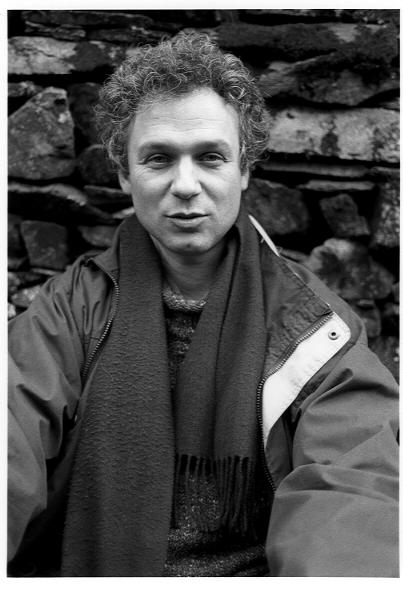
Tell me about your background. Where were you born and brought up?
I was born in Dundee and brought up in the West End of the town: the
area around Peddie Street, Blackness Avenue and the Perth Road constitute my
motherboard. I'm not very good at remembering place names and street names,
but those of that part of town have continued resonance: Logie, the
Sinderins, Magdalen Green. I went to school in the now demolished Blackness
Primary, like my mother and grandmother before me -- even when we moved out
of the tenement and into the brand new multi-storeys up at Trottick: every
day I'd be taken over and dropped off, and I'd have lunch at my maternal
grandparents, who lived in Corso Street. Corso being the Italian for street,
they lived in Street Street, which feels fairly central.
I lived for two years on the fourth floor of Claverhouse Court, (Bloody
Clavers of the suppression of the Covenanters, Bonnie Dundee of the 1688
rebellion). One of my various uncles lived on the tenth, and we weren't far
from Kirkton, where my other grandparents lived in a prefab. When I was
eight we moved down to Broughty Ferry, which is on the Firth of Tay. One
grandfather was originally a gardener in the big houses of the Jute Lords,
and came from the Ferry, so in a sense this was home from home. I became
fairly obsessed with the river Tay in my teenage years and would spend long
periods gawping at it from various benches, particularly those in front of
the Orchar Gallery, where there is a sweep of pebble beach between the stone
pier and the timber one. I can confirm after a long search for alternatives
that it is indeed 'silvery'.
As you can tell the resonance of place is very important to me, and Dundee
remains my problematic root: the town was gutted by change in my childhood -
disastrous in terms of its heritage and appearance. By my teens it seemed a
place in terminal depression: rundown, dispirited, lacking even a vestigial
trace of culture, the home of William 'Worst Poet in the World' McGonagall,
and the union-breaking hand in the Beano-producing fist that was D.C.
Thomson's, our couthy wee Citizen Kane. It was the capital of the Philistine
Empire, its radical history and literary past unknown to its own citizens, a
brown sandstone necropolis of shortbread, 'pehs' and tartan tat, a new
circle in Hell, in Hugh MacDiarmid's words. It was obviously an eminently
fit subject for poetry.
Do you come from a literary family?
The first Herbert to crawl out of the Devonian slime of the prehistoric Tay
was a circus show-man who arrived in town towards the end of the nineteenth
century. His offspring ran a scrap merchant's on the Clepington Road, and
their offspring shifted religion from Protestant to Catholic back and forth
every generation till mine - one son was thrown out of his inheritance for
the love of an Irish girl, which sounds sort of literary. On the other side,
my maternal great-grandfather worked on the same railway that plunged a
train into the river in the Tay Bridge disaster of 1879, 'lamented' in
McGonagall's poem, which is practically literary. Fortunately he wasn't on
it.(My great-grandfather, that is, though I've grown to feel much the same
about McGonagall.)
My family worked in the jute mills, sorted wool, were in domestic service,
worked in the shipyards. My father was a process engineer at Timex and my
mother was a primary school teacher in Lochee. My Uncle David lectures in
print design at Duncan of Jordanstone Art College. My maternal grandfather
wanted to be an artist and could certainly draw, but that's about it.
When did you start writing poetry?
When I was sixteen-ish. Up till then I'd written stories. But then I had a succession of fine English teachers who taught poetry and drama in a vivid and powerful fashion - Forbes Browne and Gerry Baird in particular. So I learned about Brecht, John Donne, Gerard Manley Hopkins - and Norman MacCaig. That spread of writers, crossing borders and centuries but including a living contemporary figure, brought poetry to life as a formal, colloquial, cerebral, passionate art. I remember being read the washerwomen passage from Finnegans Wake as though we were all sharing a most peculiar vision, and I thought, 'This is what writing can do.'
What were the books\events that most influenced your beginning as a writer?
My maternal grandfather had a few books: two in particular influenced me. One was a huge stained tome that looked like it was made out of brown sandstone called Old Dundee Prior To The Reformation, by Alex Maxwell. It sounded like and was treated by me as though it were a kind of Bible. The other was a little pamphlet produced by Dundee students in the 50s called The Moc Gonagall, which was a series of parodies of the master's style. This was the first poetry I ever saw: some of it was in Scots; it was funny (though not as funny as its model); and it was about strange (then contemporary) issues - Picasso, Thor Heyerdahl. It was also illustrated with images of a rather rakish, perpetually-puzzled McGonagall. My work has veered between these extremes ever since.
What sort of poetry did you begin writing - what were its main themes and techniques?
The first books of poetry I bought were from a second hand shop at the foot of Tait's Lane that I would pop into on my way to visit my grandmother. These began with a small edition of Keats and the 1966 edition of Auden's Collected Shorter Poems. So, in addition to the influences picked up from school, I was trying to write sonnets and skeltonics: to rhyme, alliterate, grasp the pentameter and spring my rhythms all at once. My themes were the surrounding landscape as projection of mood, the highly pathetic fallacies of a solipsistic first-girlfriend-obsessed adolescent.
You're also known for your work in Scots. How did that begin?
It happened rather suddenly when I was 21: I wanted to write a sequence of poems about various places in Dundee - cemeteries, bus shelters, empty factories - that I felt embodied or could evoke the 'doldrums' I saw Dundee as enduring. The term was borrowed from Allen Ginsburg, and deployed with reference to Kerouac's methods in Visions of Cody - although I'd done a short dissertation on Hugh MacDiarmid as part of my final degree, I didn't think of him as a model for my own work. I hadn't written anything in Scots before this point, but the effort of focussing on the places took my eye away from the 'finish' of the notations on the page and drew this other voice out from wherever it lurks in most educated Scots.
Why is writing in Scots important to you? How does it help in expressing what you want to say? Doesn't it just reduce your readership?
I don't have things I want to say: the act of writing for me is a series of
involuntary discoveries I then feel I need to take responsibility for: to
craft them formally, and to explore them thematically. Scots is something
that exists within the range of my language - I can be more Scots, more
English, and with these more working class, more middle class; more
page-bound, more performative. Once a draft has started you can mix these
possibilities in different alchemical proportions: rough sounds with smooth
intellect, for instance. But to start with it's like the weather - you're
inside it rather than directing it.
What it - Scots - can say is only occasionally distinct from what English
can say: it does tenderness very well, it does harum-scarum pretty good. It'
s got some fantastic stanza forms it's been developing for hundreds of years
that sound rather flat in English - the Standard Habbie, the Christis Kirk,
the Cherrie and the Slae - and I'm very happy to work with the energies in
these. But the main thing it does is increase attention: you know you're
reading a poem in Scots, whereas sometimes with poetry in English, people
lull themselves into thinking it's just like what anyone else would say
(usually in prose). All the craft the writer has put into making it so
effortless is worse than overlooked - it's ignored in favour of a normative
model of language: everything's just the way we thought it was after all. I
actually don't think Scots is any different as a poetic language from
English, it just does all the stuff about sound, vocabulary and literary
resonance on the surface, it's more up front.
A lot of people push Scots away because they're not sure exactly how to
pronounce it - the phonetic spellings and the glosses for the funny words
alienates them rather than helping. But the funny words can be so beautiful:
'cwa' for 'come away'; 'clishmaclavers' for 'gossip', for 'whispers', for
'nonsense'. I think a little less timidity and 'respect' for our feelings
would help - think of Scotty off Star Trek and just plunge in! As with
anything else in poetry, the barrier is never as big as it looks at first.
As for the size of the audience - think of Burns, think of all those expats,
think of the people who discovered they could understand Trainspotting after
all. It's not the case that poetry (in any language) needs a bigger
audience; it's that a bigger audience would gain something very valuable
from poetry: the sense that things are not just the way we thought they
were, they're as beautiful and strange as an old Scots word.
To what extent do your 'roots' influence what you are writing now?
Always and constantly: I have mapped Dundee and its hinterland onto Newcastle and its surrounding countryside to an absurd extent (North Shields and Tynemouth 'equal' Broughty Ferry and Monifieth; Durham 'equals' St Andrews; Hexham 'equals' Perth. Although Douglas Dunn is not aware of this, he used to live in South Shields). I have a continuous body of poems waiting impatiently to be written about Dundee which is not interested in my efforts to move on and lighten up. And of course one of my poetic languages, my work in Scots, is based on a combination of the Dundee dialect and the older 'dictionary' Scots of MacDiarmid.
How did you first go about getting your poems published?
I sent off to local magazines: in Dundee there was AMF (I think), which was produced by Andrew Murray Scott, the novelist and Trocchi expert; in Glenrothes there was Words (I also think) which was edited by Carl MacDougall; and in Aberdeen (I think) there was Effie. I got a couple of things accepted by the last of these, but Carl MacDougall, who was in residence in Fife at the time, wrote me a few encouraging words. I was also getting printed in and producing my own student magazines. Then in 1983, Duncan Glen published all of the Dundee Doldrums in the last issue of Akros. That was the real start.
How does the way you make a living influence your poetry?
I teach Creative Writing at Lancaster University, so you could say it keeps me in a creative environment, but you'd be wrong. The usual effect is negative: as the amount of reading increases and the undergraduate marking kicks in, I find my time and brain power is squeezed almost but not quite out of existence. Actually I love teaching and the opportunities it opens out (for instance we go to the Poet's House in Ireland with our Distance Learning MA, so I've got to meet some fabulous Irish and American poets through that), but it doesn't seem directly to influence what I write.
Can you describe your most effective working method? Do you wait for inspiration, or sit down every day with the intention of writing?
I'm with Auden and Mark E. Smith on this one: you do shift-work. You sit
down every day that you're not teaching and you stare at the page or the
computer screen; you assemble your notes, you redraft. I start with phrases,
sometimes just a couple of words, sometimes a couple of lines, and I just
haul on them gently but insistently - quite a lot will usually come out, and
the rest you have to fill in afterwards as though it just came out.
Sometimes the poem only exists as an idea, a title or a notion or an image
or an itch, but there are no words to hang it on - that's when you've got to
waste time. Hang around the house in dirty clothes, video black and white
movies you won't watch, go to the pub when there's no-one else there, mooch
around the streets rationing out the caffeine intake, look at the fishing
boats or just the greasy water. Wait for the phrase. Don't go fishing. This
is fishing. Just wait for the phrase.
But mostly you can get on with it: get out an old draft, type it up, move a
few words round, see if it'll go into couplets, spot the undeveloped rhymes.
Mostly you don't think about writing, you don't talk about writing (you can
do that ad infinitum, afterwards), you just write. If it's crap, throw it
away. I throw away about a third. Another third 'works' or has the potential
to work, and the remainder gets dragged around with me for years till
something clicks or not.
How do you decide that a poem is finished?
It's not a conscious decision - sometimes you do a draft and realise that's it; sometimes you know something's wrong and you can't work out what; sometimes you know it's going to be recast into a different stanza structure or line length; sometimes it's just sitting around waiting for something to replace the humdrum sections; sometimes there is no solution and time or the wastepaper basket must intervene. But the point at which it's actually done is rarely a decision - instead you just become distant from it, and it becomes separate from you. Which is not to say that you won't want to just change a little something when you see it in print. Publication can bring its lovely flaws back to you like a reconciliation.
How important to you are formal workshops, or getting the opinions of other poets about your work-in-progress?
I've always run workshops or attended them, so I imagine they serve a fairly
central purpose. When I got to university I attended one set up by Stefan
Szymanski (where are you Stef? Where is your moustache?) which gradually
became the meeting point for the student poets of my generation - Martyn
Crucefix, Keith Jebb, Rabindra Ray. It spilled over into the Old Fire
Station Workshop, which Tom Rawling inherited from Anne Stevenson, and there
we met Peter Forbes, Helen Kidd, Elizabeth Garrett. Then we seemed to be
running the Oxford Poetry Society, along with George Roberts and Gwynneth
Lewis. Some of these names may be familiar to your readers. All of them were
valuable to me in defining myself as a writer.
I think along with the importance of place I have a strong attachment to the
idea of community - not just the community of the inhabitants of a place but
that of the articulators of its history and its present moments. So the
workshop was always the mainstay of my various residencies, in Dumfries &
Galloway, in Morayshire, and in the Northern Arts region when I settled here
in '94. I currently attend a group that meets monthly which includes
established writers like Sean O'Brien and Peter Armstrong alongside good new
poets like Joan Johnson and Ally May. When I visited Madrid last year I was
introduced to the Spanish idea of the tertulia: a gathering of like-minded
people to discuss whatever they felt like, a formalising of the art of
conversation for which we only have the equivalent of the dinner party - or
the workshop. I think of this workshop (which thank God I don't have to run)
as a Tyneside tertulia - with texts.
To what extent if any do you collaborate with other artists?
I've done an amount of collaboration over the years with different sorts of
artists. I've worked with the stained glass artist Bridget Jones (no, not
that one) on a couple of things, including a set of panes for the Tourist
Offices in Dumfries. I've worked with the sculptor and calligrapher John
Nielson on a set of stones in Brockhole Park in the Lake District, inscribed
with poems produced by children I was working with in the local schools. I
made one film with Anton Hecht about Berwick called Citizen B , with kids
from Berwick High; and another about Dundee with Valerie Lyon for Scottish
Television, called Dour Fun. I've worked with the jazz composer Keith Morris
on a couple of projects involving poetry and strange combinations of highly
talented musicians (Four Seasons, Songs from the Drowned Book), and I think
that will carry on. I collaborated with two Glasgow poets, David Kinloch and
Donny O'Rourke, for a verse show called On Your Nerve about the New York
poet Frank O'Hara, which we put on at Mayfest.
Probably the main collaboration I've been engaged in in recent years is Book
of the North, a CD-ROM project I devised which involved five poets, five
prose writers, and five visual artists. This spawned various exhibitions,
performances, texts and even a radio programme. The CD is being assembled at
the moment. The participants are in therapy.
Who do you write for? - Do you have a particular audience or person in mind?
Part of my obsession with community is really an obsession with audience: to understand what the audience will understand, to become that audience, is very much part of my aims in writing a poem. Not so you give them what they want, or, worse, what you think they will understand (most attempts to second guess an audience are disguised condescensions), but so you yourself feel grounded, verbally and emotionally, for wherever the poem is going to take you. So my audience-person is a me who's not me, it's the people I meet but now they want to read a poem, it's my fellow writers as though they'd never read me before. The audience is a fiction created by the desire to be read, then it turns into real people who give me their money. Another miracle.
Does poetry have to be 'simple' to get a hearing?
A poem has to be incredibly complex in the precise sense of 'incredibly': it must not be credible to the reader that it's anything other than a simple statement. Even if it's packed with arcane reference, in a complex metre, full of unfamiliar vocabulary, the reader has to believe that this is the simplest way that what the poem is saying can possibly be said. They have to believe this even when they're not sure what the poem is saying, so that they're given the faith to persist. If you can't transmit that conviction to the reader then it doesn't matter how 'direct' or 'obscure' your poem is, it has failed to communicate even that it has something to communicate. It's just a noise that came out of you. That's why musicality and form are so important: they underscore tone, they precede comprehension. As Eliot said, you don't have to understand a poem the first time you read or hear it, or it just becomes another one of society's disposables, a baby-wipe for the intellect. But you do have to believe in it, so that the poem can live with you, and reveal its complexities through long acquaintance.
Which of contemporary poets do you find most interesting?
I'm a Scot living through one of the most significant periods of writing my
small country has produced for some time. Scottish culture, whether in the
art of the novel, in the visual arts, or in music, is undergoing a fabulous
period of growth, and this is true of Scottish poetry. I'm glad to have
contemporaries like Robert Crawford, David Kinloch, Kathleen Jamie, Don
Paterson, John Burnside, Tracey Herd, John Glenday and Roddy Lumsden. I'm
proud that several of them come from or are now associated with Dundee, that
it's become a citadel of poets. Their work displays an astonishing range of
interests and skills: technology, language, gender, sexuality, the
spiritual - it's a blueprint for an emerging nation, a new definition of
what it is to be Scottish. And in this they are preceded by a series of
older poets in addition to those I've mentioned elsewhere, some gone, some
very emphatically still with us - Douglas Dunn, Liz Lochhead and Edwin
Morgan being among the latter; and Iain Crichton Smith, George Mackay Brown
and Sorley MacLean among the former.
But I am also powerfully drawn to the diverse work done by Northern English
poets - the Huddersfield poets Simon Armitage and Geoff Hattersley, Hull's
own Sean O'Brien and Peter Didsbury, Ian Duhig in Leeds, the late lamented
Barry MacSweeney here in Newcastle. I think many of these writers developed
or are developing along the lines put down by the decentered masters, Tony
Harrison and Douglas Dunn, by the Northern Irish poets, and the modernist
line that descends through Basil Bunting and the American poets who visited
the Morden Tower in the 60s. There's a kind of Hadrian's Wall of the
intellect that needs to be over-run in both directions, and a
cross-fertilisation that could take place.
Which trends in modern poetry do you find most interesting?
One of the shifts that's been engaging me lately is a slight relaxation of the trench warfare between the 'experimentals' (writers associated with Cambridge) and the 'mainstream' (writers associated with London). These groups have tended to cluster in separate anthologies, and to pursue parallel existences on their respective readings circuits and in their critical pantheons. But neither category really covers the diversity of work being produced, nor the range of places in which poetry is now being originated, nor the reading tastes of many of the poets classified as belonging to one or the other camp. And of course the public remains largely oblivious and rightly disinterested throughout. But I think the work of category-straddlers like the Australian poet John Kinsella, and the efforts of publishers like Bloodaxe to produce books across the divide, are positive steps. If this debatable land too could be crossed, I feel the poetry produced in these islands would benefit from a general loss of blinkers.
Does poetry have any influence outside poetry?
Does love have any influence outside love? Does sex? Like these, poetry has interesting problems with its boundaries. Notions of the poetic infect every layer of our society: as Tom Leonard says, a beautiful piece of football isn 't called 'prosaic'. Films, prose itself, even cookery, are all happily dubbed 'poetic' when people are looking for an approving term. Actual poetry, however, mainly casts a negative shadow: it's the source of cheap laughs and journalistic put-downs, it performs that role of scapegoat for the defensive, for whom poetry's easy to do and easy to denigrate. Except it 's not particularly easy to write a good poem, and such a poem is never denigrated, it spreads and percolates till it replaces the language in our mouths and its ideas shape the way we look at the world. Of course the other arts do this too: we can't not 'see' perspective now it's been pointed out, and the sway of the novel is omnipresent - the narrative of a writer's life, for instance, is considered far more important than the consonance of his or her ideas. But poetry is the touchstone, the reassurance we unconsciously seek at moments of crisis, the challenge we rise to at points of development and learning. It is pleasurable and private and deeply satisfying, momentary but repeatable, a bit scary, always the same and never the same - and if that sounds kind of sexual I think that is about right.
Do you see 'performance poetry' and 'slam' as sideshows or a return to the origins of poetry as story-teller and social conscience?
Every good poem is a return to origins, and every reading of it echoes the
prior condition of poetry as oral, as memorised. Books are just paper
memories, their invention means we don't have to recall everything, like the
Gaelic bards had to; and we don't have to read to others when they can read
to themselves. So the act of reading out loud really belongs in an
unnecessary zone, where performance is for taking pleasure in the poem and
no longer for its survival. But pushing the boundaries of 'useless' pleasure
is what poets are here for, and that's what a good reading explores. I'm
very committed to the act of reading as an entertainment that challenges,
and not as an ordeal or an emollient. There are too many readings where I
hear the same few poems from the same few poets because the organiser didn't
have the imagination to pick someone different. The audience is unlikely to
be bored to death (most modern poets have honed their people skills), but
they're equally unlikely to hear something new.
I'm not engaged by the aspect of competition in slams (there's enough of
that in the poetry world already), but I am entirely in favour of the
performance as a transforming experience for reader and audience. Lorca has
a line about being prepared to fight the complacency of everyone in the
room: 'Not to give you honey (I have none) but sand or hemlock or salt
water.' I think even Socrates would have accepted a little honey in the
hemlock, but looking at the same gilded few as they yell, 'Hello Hicksville,
are you ready to rhyme?' I know what he means.
What use do you make of the internet?
I'm part of a discussion list that debates poetry when it can get its mind off the football or whatever has caught our collective attention this week. I did a website as part of a residency for TrAce, the online community 'based' at Nottingham Trent - and I am definitely going to revise and upgrade it this summer (and that's your Lazy Bastard Guarantee). It contains work by myself and other writers I'm interested in - more a kind of gallery than a webzine, I suppose. I teach a distance learning MA as part of my Lancaster Uni work, which involves conferencing if not the net. And I spend some part of most days rummaging around on the net or using synthesizer or drum machine or image editing software for one or another loosely net-related end.
Is internet publishing just a cheaper way of getting your poems seen by a wider audience, or is it liable to produce new kinds of poetry?
'Yes' would be the short unhelpful answer. For me it hasn't yet developed into a terribly new approach - I tend just to use hyperlinks to point to the 'information' behind a word. I've seen more indeterminately-ordered hypertexts, texts with elements of animation, texts with soundtracks, and I' ve been entertained by them without being convinced that they're actually new forms, rather than forms which have admitted new elements. But that's where we're all at just now: such modes of writing are in their infancy and our capacity to appreciate them is similarly youthful, with the resulting attributes of boundless energy and gaucheness on both sides. I'm not sufficiently aware that there are writers who're totally committed to the net rather than print, and, though I don't think it need be that exclusive, I suspect that's a stage things will have to go through to convince everyone that radically different types of work can be done.
What are you working on at the moment?
I've just finished co-editing a book called Strong Words with Matthew Hollis. It's a collection
of statements by poets about poetry, beginning with Ezra Pound and covering
both sides of the Atlantic till about the 60s. The second section is more
British Isles-based and includes over 30 statements by contemporary writers,
usually specially commissioned, some selected by the poets or edited by them
from what they consider to be their clearest articulation of their
principles. That'll be out in the Autumn from Bloodaxe.
I'm still in the act of finishing my next book of poems, which is nearly
about living in an ivory tower but not quite - we moved last year into an
old lighthouse above the Fish Quay in North Shields, and I'm using the view
from my upstairs study to see as far as Moscow, Dundee, and Madrid. It's
about the way that people give themselves to cities as though to lovers, and
the way that cities, like lovers, contain secrets, betrayals, and unknown
children. When Dundee was being demolished in the 60s, the company
responsible was called 'Trojan', and a certain timber equine has a part in
the proceedings.
I've also embarked on a new long poem, but I'm intending to hive that off as
a separate volume - my last book was too long for the reviewers, poor dears,
though I hope it's still providing value for money for my loyal readers. It'
s a narrative set in medieval Dundee that's in very strict form but has
pretty laid-back morals. Offers for the movie rights will be considered
presently.
Bibliography
Pamphlets
- Sterts and Stobies (with Robert Crawford), Obog, 1985
- Severe Burns (with Robert Crawford and David Kinloch), Obog, 1987
- Other Tongues (with Meg Bateman, David Kinloch and Angela McSeveney), Verse Publications, 1990
- Dundee Doldrums, Galliard, 1991
- Anither Music, Vennel, 1991
- The Landfish, Duncan of Jordanstone, 1991
Collections
- Sharawaggi (with Robert Crawford), Polygon, 1990
- The Testament of the Reverend Thomas Dick, Arc, 1994
- Forked Tongue, Bloodaxe, 1994
- Cabaret McGonagall, Bloodaxe, 1996
- The Laurelude, Bloodaxe, 1998
Critical/Editorial
- To Circumjack MacDiarmid, Oxford University Press, 1992
- Strong Words (ed. with Matthew Hollis), Bloodaxe, 2000 (forthcoming)
© Ted Slade, William Herbert, August 2000